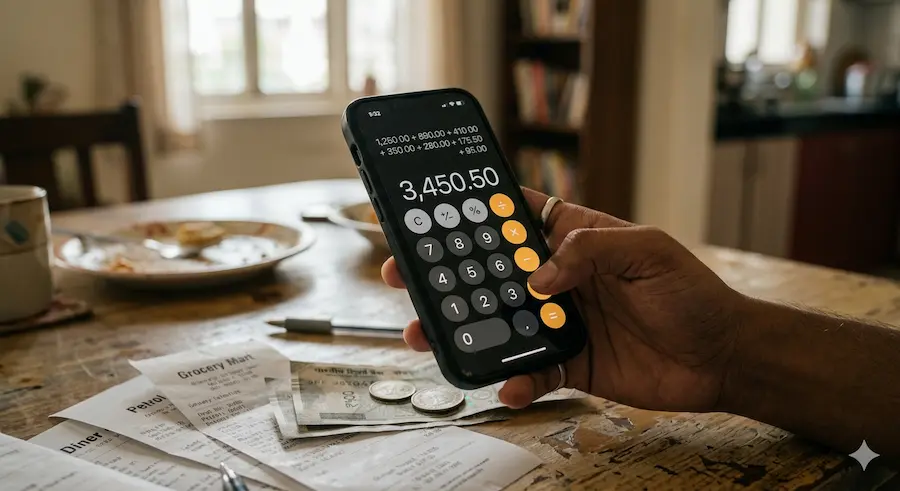
Most people have a vague sense of where their money goes. Groceries, rent, the occasional dinner out. A few subscriptions. Clothes sometimes. The picture is impressionistic — accurate enough to feel known, imprecise enough to be completely wrong about what's actually happening.
Tracking every purchase for 60 days replaces the impression with data. And the data, almost universally, contains at least one surprise that the impression had been quietly hiding.
This is what two months of recording every single transaction — from the ₹20 chai at the tapri to the quarterly subscription renewed without thinking — looked like, and what it changed.
Why 60 days and not 30
The first month of tracking is well-behaved. Behaviour changes under observation — a well-documented phenomenon. The person tracking their spending in month one spends slightly more carefully, makes slightly more deliberate choices, notices things they might otherwise have ignored. The data from month one is cleaner than normal life.
Month two is where normal life reasserts itself. The novelty of tracking has worn off. The friction of recording has reduced from effort to habit. What emerges is a more honest picture of actual patterns — the second Tuesday coffee, the evening scroll that ends in a cart, the thing bought because a friend mentioned it.
Sixty days gives you both: the intentional version of yourself from month one, and the habitual version from month two. Comparing the two is itself instructive.
Record every purchase within 60 seconds of making it. Not at the end of the day, not weekly — immediately. The friction of delayed recording is where most tracking attempts fail. A phone note with four fields — date, amount, category, one-word trigger — takes fifteen seconds and captures everything needed for analysis.
The setup — how to actually do this
- Choose your recording method before day one. Phone notes app, a small notebook carried everywhere, or a simple spreadsheet. The method matters less than having it decided and ready before the first purchase of the experiment.
- Define your categories in advance. Eight broad categories: groceries, eating out, clothing, home and personal care, subscriptions, transport, entertainment, miscellaneous. Resist adding more until week three, when genuine subcategory needs will have emerged from the data itself.
- Add a trigger field. After category, record one word for what preceded the purchase: bored, hungry, social, habit, need, impulse, planned. This single field generates the most valuable data in the entire experiment.
- Review weekly, not daily. Daily review creates anxiety without useful pattern recognition. Weekly review allows enough entries to see shape. Set a recurring 20-minute slot — Sunday evenings work well — to add up each category and note any patterns.
- Do not judge entries as you record them. The tracking is observation, not confession. An honest record of what actually happened is more useful than a curated record of what should have happened.
- At day 30, review before continuing. What categories are higher than expected? What trigger word appears most often? What single change would have the highest impact? Note these observations and continue into month two to see whether they hold.
What the data tends to reveal
After comparing notes with others who have run similar experiments, a handful of patterns emerge consistently across very different spending profiles:
The category you thought was small is usually not
For most people, one category is significantly larger than their mental model suggested. It is different for different people — for some it is food delivery, for others subscriptions, for others small daily purchases that individually feel trivial. Whatever it is, the gap between the imagined amount and the actual amount is usually the most useful finding of the entire experiment.
The trigger word tells you more than the amount
Knowing you spent ₹4,000 on clothing in two months is information. Knowing that 80% of those clothing purchases had "impulse" or "social" as the trigger — rather than "need" or "planned" — is insight. The trigger field transforms spending data from a ledger into a map of behaviour. This connects directly to the principles behind a no-buy month — both experiments are fundamentally about making the unconscious visible.
Subscriptions are almost always higher than remembered
Most people underestimate their subscription total by 40-60%. The combination of annual renewals (which don't feel like monthly costs), free trials that converted silently, and services shared across devices creates a number that is genuinely surprising when tallied. A subscription audit in week one of tracking often produces the first immediate action of the experiment.
Evening purchases skew impulsive
Adding a time field to the trigger data reveals a consistent pattern: purchases made after 8pm have a significantly higher proportion of impulse triggers than purchases made during the day. This mirrors what digital minimalism research finds about phone usage — the depleted-willpower evening hours are the most commercially exploited part of the day.
Personal care — the category that includes everything from shampoo to skincare to the random item picked up near the checkout — tends to be the most underestimated. Individual purchases are small enough to feel negligible. The cumulative total over 60 days is often the first genuinely shocking number in the data.
This is part of what makes switching to homemade personal care compelling beyond the ingredient transparency argument — the cost reduction is real and measurable.
Real-life applications — what changes after the data
The point of 60 days of data is not the data itself. It is the one or two changes that the data makes obvious. These are the changes most people make after completing the experiment:
A subscription audit
List every subscription. For each one: when did you last use it? Would you notice if it disappeared tomorrow? Cancel everything that doesn't pass both tests. Most people cancel 2-4 subscriptions immediately. This is the fastest return on any action the experiment produces.
One category cap
Take the category that was most surprising and set a monthly cap — a specific amount written down somewhere visible. Not a ban, just a limit. The 30-day rule applied to that specific category is a natural companion: wait 30 days before any non-essential purchase in it.
An evening rule
If the data shows evening purchases skewing impulsive — and it usually does — make one rule: no online purchases after 9pm. The purchase can still happen; it just happens tomorrow, after sleep, when the depleted-willpower state has reset. Most purchases that seemed necessary at 10pm seem optional at 9am.
Making more at home
Many people find that the personal care and grocery categories contain a significant number of things that are straightforwardly makeable. Peanut butter, granola, cleaning products — the spending data makes the value of homemade alternatives concrete rather than theoretical.
"The trigger field transforms spending data from a ledger into a map of behaviour. Knowing the amount spent is information. Knowing what emotional state preceded each purchase is insight."
What the second month revealed
The second month of tracking tends to show one of two things: either the patterns from month one were anomalies (the clothing splurge was a one-off, the restaurant spending was a social period that passed) or they were habits that persisted even under observation.
The habits that persist into month two are the ones worth targeting. Not with guilt — with systems. A specific rule, a friction point, a substitution. The capsule wardrobe is a system that targets clothing spending at the root. The organised home reduces the "I can't find it so I'll buy another one" purchases that appear in multiple categories.
Systems beat intentions every time. The data from 60 days of tracking identifies which systems are worth building. That is what the experiment is for.
Sixty days. One note per purchase. Four fields. The data that emerges is not remarkable in itself — what is remarkable is how different it looks from what was expected. That gap between the imagined spending life and the actual one is worth the sixty days entirely on its own.
Common questions
What's the best way to track purchases — app, spreadsheet, or notebook?
The best method is the one you will actually use consistently. A notes app on your phone captures things immediately at the point of purchase. A simple note with date, amount, category, and one word for what triggered the purchase is enough. Review weekly and transfer to a spreadsheet for pattern analysis. The notebook is the most honest because writing by hand slows you down enough to notice what you're recording.
Does tracking spending actually change behaviour, or does it just produce data?
Tracking changes behaviour through two mechanisms. First, recording a purchase immediately after making it creates a moment of reflection that wasn't there before. Second, the weekly review makes patterns visible in a way that general awareness does not. Most people know roughly what they spend. Very few know which specific category or emotional state drives the majority of their discretionary spending.
What categories should I use — how detailed should the tracking be?
Start broad: groceries, eating out, clothing, home, personal care, subscriptions, entertainment, miscellaneous. Resist the urge to create subcategories immediately — they add friction and reduce consistency. After two weeks you will know which categories need splitting because the entries in them will feel meaningfully different from each other.
How do you track purchases made by other family members?
For a household tracking exercise, the most practical approach is to track your own purchases only, then have a weekly conversation about shared spending. Trying to enforce a tracking system on others rarely works and introduces friction into relationships. Your own spending patterns will still reveal a great deal.
What do you do with the data once you have 60 days of it?
Three things. Identify the one or two categories where spending was higher than expected. Identify the purchases that brought the most genuine satisfaction versus the ones forgotten within a week. Then make one specific rule change based on what you found — not a broad resolution, but a specific constraint targeting the pattern you identified.
Is 60 days necessary, or is 30 days enough?
Thirty days captures one cycle of behaviour. Sixty days captures variation — what happens when the novelty of tracking has worn off, whether the patterns from month one persist or were anomalies. The second month is where the most honest data tends to emerge. If 60 days feels too long, do 30 with the intention of extending if you find it useful — which most people do.