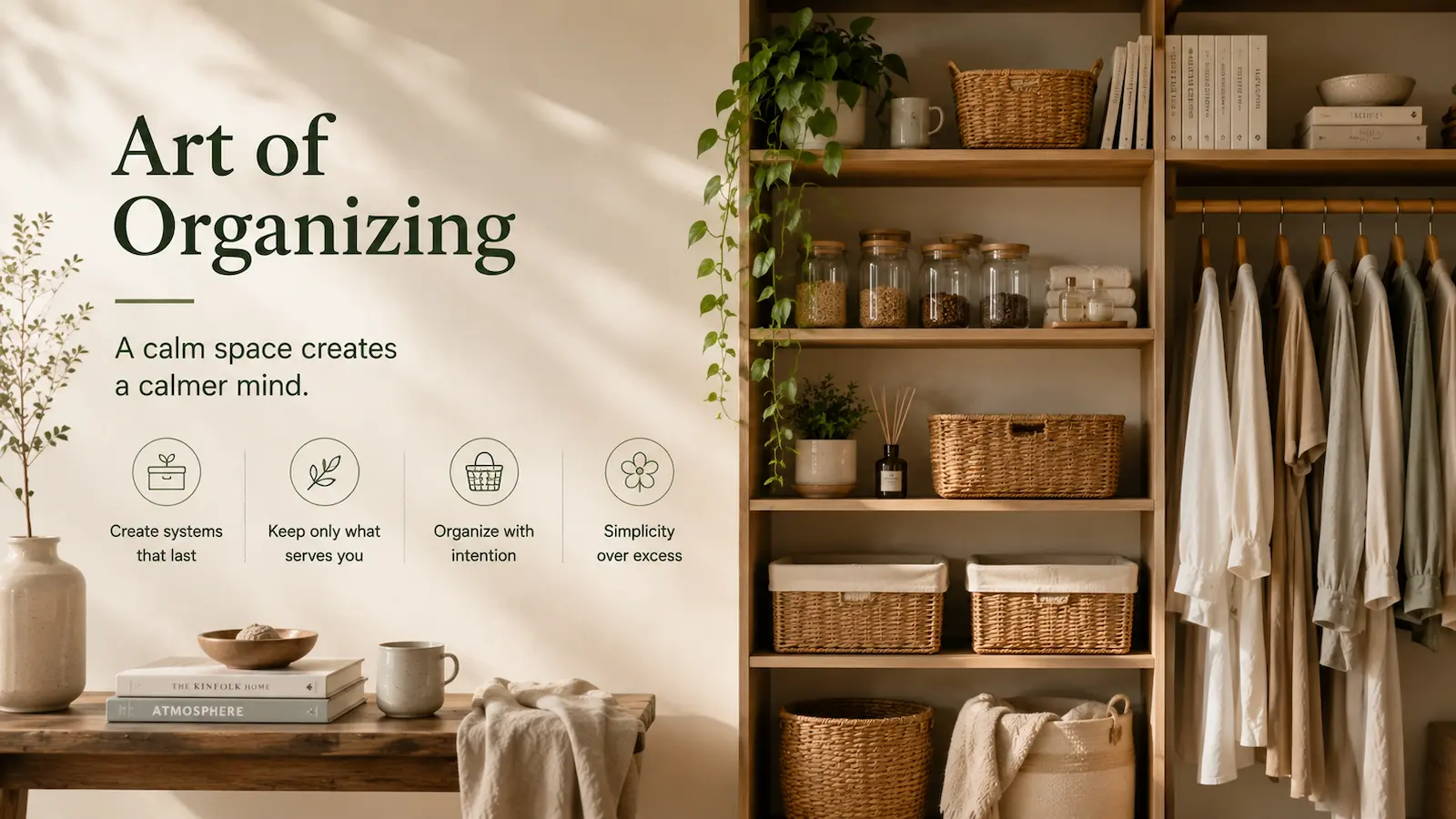
There is a version of organizing that most of us have tried: a frantic Sunday afternoon, a trip to a storage shop, baskets lined up neatly on shelves. By Tuesday, the baskets are full of clutter too. This is organizing as performance — it looks right but changes nothing.
The art of organizing, as it is being rediscovered today, is something far quieter and more radical. It is an intentional process of simplifying life — not just tidying surfaces, but reducing the mental chaos that accumulates when our spaces, routines, and even our thoughts are overloaded with things that no longer serve us.
"Organizing is not about perfection. It is about efficiency, reducing stress, and freeing time to do the things that matter most."
The glider and the airplane
One of the more useful metaphors for understanding disorganized thinking comes from the philosophy of mental organization: the difference between a glider mindset and an airplane mindset. A glider waits — for wind, for momentum, for someone else to set the direction. It reacts. An airplane self-propels. It has a destination, navigates with intention, and carries its own energy forward.
Most clutter — whether in a wardrobe, a desk drawer, or a to-do list — accumulates in glider mode. We defer decisions. We hold onto things "just in case." We wait until the chaos becomes undeniable before acting. Shifting to airplane mode means building the habit of deciding promptly: does this stay, or does it go? Does this task matter, or is it filler? Does this thought deserve space, or can it be released?
Always declutter before you organize. Purchasing new containers for existing clutter does not solve the problem — it simply makes it neater. Remove what does not belong first. Only then should you decide how to store what remains.
Five principles of home organizing that actually work
Decades of professional organizing research, from Japanese minimalism to North American decluttering movements, have converged on a surprisingly consistent set of principles. These are not rules — they are orientations that, once internalized, make organized living feel natural rather than effortful.
1 — Declutter before you store
This is foundational and counterintuitive enough that it bears repeating. The organizing industry profits from selling storage. But buying a new shelf before removing what you do not need simply relocates the problem. The first task is always subtraction.
2 — Divide and conquer
The single biggest reason organizing projects fail is scale. "Reorganize the house" is not a task — it is a daunting, shapeless ambition that leads nowhere. "Organize the left kitchen drawer" is a task. Break every job into the smallest possible discrete step, complete one, and stop. The momentum builds naturally.
3 — Organize by category, not by room
Rooms lie. You might have jumpers in the bedroom, the hallway cupboard, a guest room, and a storage box under the bed. Organizing the bedroom alone gives you an incomplete picture. Category-based systems — gathering all clothes, all books, all papers — show you the full reality of what you own and make permanent decisions possible.
4 — Know your why
Organization without motivation rarely lasts. Before beginning, take a few minutes to articulate what you are actually working towards. A calmer morning routine? A workspace that allows focused thinking? A home that feels genuinely restful? Keeping this image clear makes the harder decisions — what to release, what to commit to — much easier in practice.
5 — Maintain with routine, not willpower
Organization is not a one-time event. It is a series of small, repeated decisions. Seasonal routines — rotating wardrobes as the weather changes, reviewing pantry staples before restocking, clearing paper piles weekly — replace the exhausting annual overhaul with manageable, consistent maintenance. Systems, not willpower, are what sustain order over time.
What the world's leading organizers actually recommend
Several thinkers and practitioners have formalized organizing into distinct methodologies. Each addresses a different dimension of the problem — physical space, visual clarity, practical systems, and mental clarity respectively.
Organize by category rather than room. Keep only what genuinely sparks joy. Handle every item to make a conscious decision — not a deferred one.
A six-step system grounded in colour-wheel logic — using visual cues and practical sequences to create organization that is intuitive to maintain.
Simple, replicable principles that address the emotional resistance behind disorganization — not just the physical reality of it.
Applies organizing principles to the mind itself — using selective forgetting, idea incubation, and deliberate attention to reduce cognitive clutter.
Know your organizing style — the ClutterBug philosophy
One of the reasons generic organizing advice fails so many people is that it ignores individual differences. The ClutterBug philosophy, developed by organizing expert Cas Aarssen, proposes that we each have a natural organizing style — and that working with it, rather than against it, is what makes the difference between systems that last and systems that collapse within a fortnight.
Loves visual organization, prefers things out of sight. Thrives with closed storage and hidden systems.
Detail-oriented and methodical. Prefers precise labelling and logical, detailed systems.
Needs visual access to everything. Open shelves, clear bins, and visible systems work best.
Creative and big-picture. Prefers simple, broad categories rather than granular detail.
Understanding your type does not excuse disorganization — it informs which systems you will actually sustain. A Cricket who buys opaque storage boxes will never use them consistently. A Bee given a simple "dump drawer" will find it intolerable. Match the system to the person, and maintenance becomes nearly effortless.
The 36-item challenge — a place to begin
If a full declutter feels too large to start, one of the most effective entry points is the 36-item challenge. The premise is deliberately modest and gamified enough to feel enjoyable rather than burdensome.
36 decisions. One room. One afternoon. A surprisingly powerful start.
Walk through any single space and identify twelve things to throw away (expired, broken, beyond use), twelve things to donate (usable but unwanted, duplicates, outgrown), and twelve things that simply belong somewhere else and have drifted. In under an hour, thirty-six items have been resolved — and the space already breathes differently.
Expired pantry items, duplicate kitchen tools, clothes kept out of guilt rather than love, chargers for devices you no longer own, books you finished and will not revisit, décor that fills space rather than delighting you. Most of us can find twelve items in any room within minutes.
Organizing as self-care
There is a framing of organization that treats it as a chore — something dutiful and joyless, squeezed into a weekend when the mess becomes impossible to ignore. This framing misses something important.
An organized environment reduces cognitive load. When you can find things easily, when your home has a logic you understand, when surfaces are clear rather than stimulating, your nervous system quiets in ways that are measurable. Less time spent searching. Fewer decisions about where things go. More mental space for the work, the relationships, and the experiences that actually constitute a life.
"True organization is not about buying products. It is about creating systems that allow you to find items easily — fostering long-term calm and wellbeing."
When we organize thoughtfully, we are not just tidying a room. We are making a series of decisions about what we value, what we want to maintain, and what we are ready to release. That is not a chore. That is, in a very real sense, the work of building a life that fits.
Start small. Pick one drawer, one shelf, one corner. Remove what does not belong. Find a home for what does. Notice how it feels. Then move to the next thing. The art of organizing is not a project with an end date — it is a habit of attention, practiced daily, in the direction of a quieter and more intentional life.