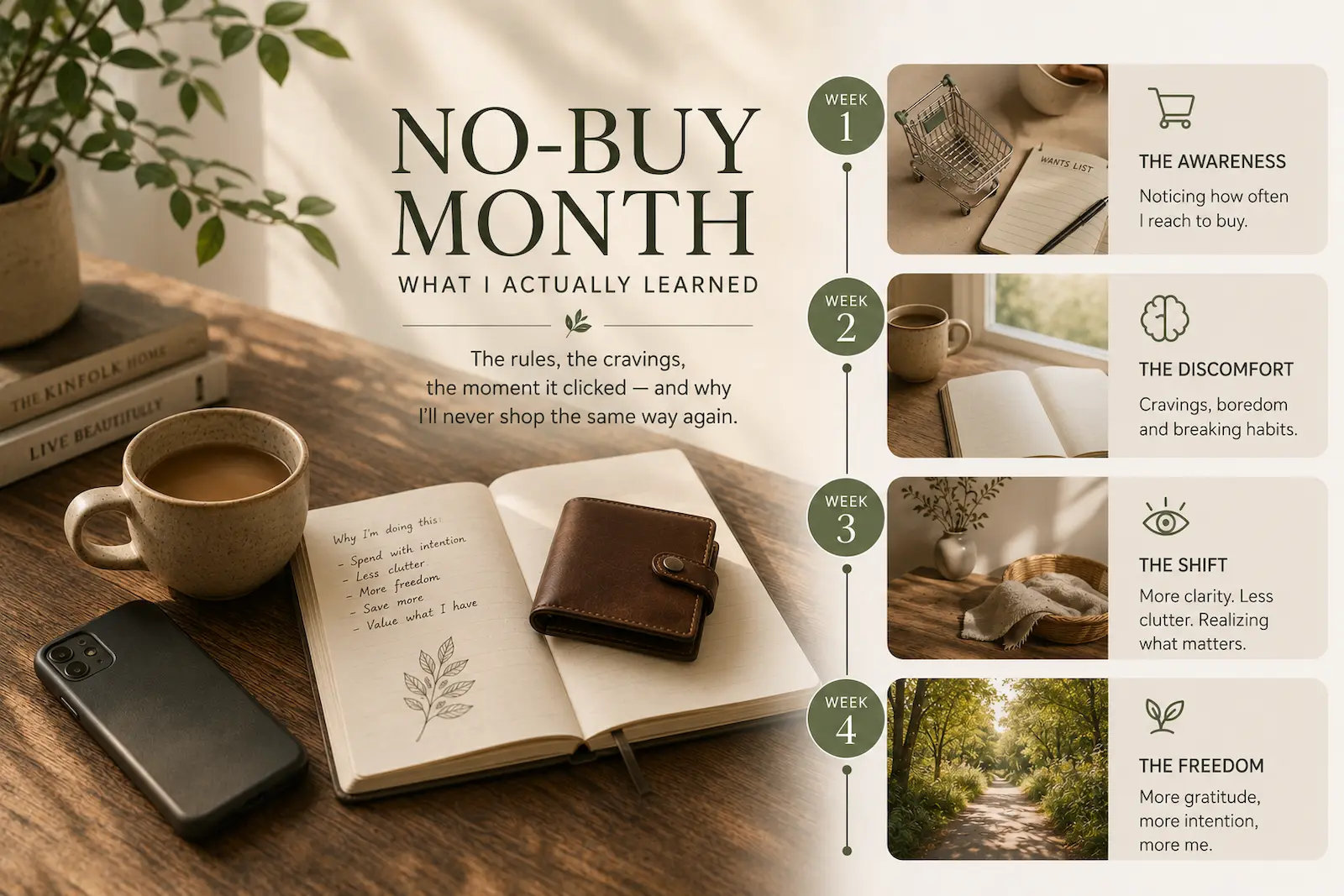
There is a particular kind of discomfort that arrives when you are standing in a store — or scrolling through one — and you pick something up, hold it, feel the small dopamine hum of potential, and then... put it back. Not because you cannot afford it. Because you decided, this month, that you would not.
That moment of putting something back is not heroic. It is not even particularly difficult, most of the time. But it is clarifying in a way that no amount of reading about minimalism or waiting 30 days before buying had quite managed to be. It is the difference between understanding something intellectually and understanding it in your hands.
This is an account of one no-buy month — the rules, what happened, what surprised, and what stayed after the month ended.
What a no-buy month actually is
A no-buy month is a 30-day experiment in which you pause all non-essential purchases. Not a fast, not a punishment — an experiment. The word matters. An experiment has a hypothesis, a period of observation, and conclusions. A restriction just has willpower, and willpower runs out.
The rules are yours to set, but the most common version looks like this:
- Essentials allowed: groceries, medicine, transport, bills, hygiene
- Everything else paused: clothes, homeware, beauty, books, apps, food delivery, takeaway coffee
- Wants are noted down, not acted on
- The month is treated as observation, not deprivation
The clearest version of the rule is this: if you ran out of something, you can replace it. If you just want something, you write it down and wait.
Spend 20 minutes before the month begins writing down everything you spend on in a typical week — by category, not amount. Most people are surprised by what appears on the list. That list becomes your baseline and your first piece of data.
The step-by-step setup
- Define your rules in writing. Vague rules create loopholes. "No unnecessary spending" invites endless negotiation. Specific rules remove the need to decide in the moment — the decision was already made.
- Create a waiting list. Every time you want to buy something, write it down: the item, the date, why you wanted it. This list is your most important tool — it turns impulse into information.
- Audit your subscriptions on day one. Many no-buy participants discover three or four subscription charges they'd forgotten about. Pausing or cancelling even one often creates the first small sense of agency.
- Tell someone. Not for accountability theatre — just so you're not navigating social situations alone. "I'm doing a no-buy month" is a complete sentence that most people respect immediately.
- Plan the hard days in advance. Weekends, paydays, sales events, and stressful Wednesdays are predictable. Knowing they're coming means you can make your choices before they arrive rather than in the middle of them.
- Review the waiting list weekly. Not to resist — to observe. What categories keep appearing? What time of day do most entries get added? What feeling preceded the want? The patterns are the whole point.
What happens in the first week
The first three days of a no-buy month are the strangest. Not because the cravings are intense — they usually aren't — but because you become suddenly aware of how often you were reaching for spending as a response to something else entirely.
Boredom. Mild anxiety. The need for a small reward after finishing something. The social reflex of responding to a friend's "have you seen this?" with clicking the link. None of these are about wanting the thing. They are about the behaviour of reaching — and a no-buy month makes the reaching visible in a way that is difficult to unsee.
The hardest moments were not in stores — they were online, at 9pm, when the phone came out and the hand moved toward shopping apps the way it might move toward the biscuit tin. Not from hunger. From habit.
What helped most was having something to do with the hand instead. Closing the app. Opening a book. Making tea. The replacement doesn't need to be meaningful. It just needs to be something.
Real-life applications — what it looked like in practice
A no-buy month is not lived in the abstract. It lives in the specific moments where spending would normally have happened. Here is what those moments looked like and what changed:
The grocery run that stays a grocery run
One of the most consistent spending leaks for many people is the supermarket or online store that starts as groceries and ends twenty minutes later with three things that weren't on the list. During a no-buy month, the list becomes the boundary. Arriving with a list and leaving with only the list is a small discipline that compounds over the month.
The online cart that stays open
Rather than closing browser tabs with items in carts, try leaving them open. At the end of the month, go through every open cart. The things that still genuinely interest you after 30 days are the things worth considering. The rest — and it is usually most of them — will feel faintly puzzling. Why did I want that?
The social spending that isn't actually social
Much of what feels like social spending — the coffee you grab before a meeting, the thing you pick up while walking with a friend — is not really about the thing. A no-buy month makes visible how much spending functions as social punctuation rather than genuine desire. Most of it can be replaced with the actual socialising without loss.
For a more structured approach to understanding your wardrobe spending, the principles in building a capsule wardrobe translate directly — owning less but better applies to buying patterns too.
The moment it clicked
For many people who do a no-buy month, there is a specific moment somewhere around week two or three when something shifts. The month stops feeling like restriction and starts feeling like relief. The constant low-level noise of "I should get that", "I need to check if that's on sale", "I wonder if they have it in another colour" — quietens.
This is not the peace of having everything you want. It is the peace of having taken the question off the table for a while.
"The month stops feeling like restriction around week two. What was once background noise — I should get that, I wonder if it comes in another colour — simply goes quiet."
What most people report is not that they stopped wanting things. It is that they became much better at distinguishing between wanting something and just being in a wanting state. The wanting state is a mood. The thing is just the nearest object.
This is related to what intentional home organisation tries to achieve physically — reducing the things that occupy space and attention. A no-buy month does the same thing with the impulse to acquire.
What the waiting list revealed
After 30 days, looking back at a waiting list is one of the more instructive things you can do. A few patterns tend to emerge clearly:
- Most entries cluster in the evenings. Specifically between 8pm and 10pm. This is not a coincidence — it is when the day's depletion is highest and the phone is closest.
- A handful of categories dominate. For most people, 70% of entries fall into two or three categories. Knowing your categories is more useful than knowing your total spend.
- Very few items still feel necessary. Of a list of 30 items, most people find 2-5 that they still genuinely want a month later. Those are worth buying. The rest were moods.
If you want to go further with the data, the next step is tracking every purchase for 60 days — which takes the pattern-finding deeper and reveals the emotional triggers behind spending categories.
After the month — what actually changed
A no-buy month that ends with a spending binge has taught you nothing. But that outcome is less common than the fear of it. What is more common is a quieter, more permanent shift in the default.
Most people who complete one find they do not want to go back to the previous default. Not because spending is bad — but because they have experienced what it feels like to not be managed by it. And that experience is difficult to unfeel.
The most durable changes tend to be small and permanent rather than large and temporary:
- Keeping a version of the waiting list going indefinitely
- A 48-hour wait on anything over a set amount
- Deleting shopping apps from the phone's home screen
- Replacing one habitual purchase (the daily coffee, the lunch delivery) with a made-at-home version — like homemade staples that are both cheaper and more satisfying
The goal was never to stop buying things. It was to start choosing them.
For the physical side of what the no-buy month often surfaces — the realisation that the wardrobe, the desk, the kitchen are full of things already — decluttering room by room is a natural companion project. The two processes reinforce each other: clearing what you have makes it easier to see what you actually need.
One month. Thirty days of noticing. The experiment costs nothing — almost literally — and what it reveals about the relationship between mood, habit, and spending is worth considerably more than anything on the waiting list.
Common questions
What counts as a 'no-buy' — what are the rules?
A no-buy month means no non-essential purchases for 30 days. Essentials — groceries, medicine, bills, transport — are allowed. Everything else: clothes, homeware, beauty, books, apps, takeaway coffee — is off the list. Some people allow a small 'joy fund' of a fixed amount. The rules you set matter less than the intention behind them.
Is a no-buy month actually effective, or does it just lead to bingeing after?
The research on deprivation-based challenges suggests that a hard stop alone rarely creates lasting change. What makes a no-buy month effective is using it as a period of observation — noticing when you want to buy, why, and what you do instead. The month is a mirror. What you see in it is what you work with afterward.
How do you handle social situations — eating out, gifts, events?
This is where most people slip up because they haven't pre-decided. Set your rules before the month starts and include a social clause. For example: shared meals with people I love are allowed; solo coffee runs are not. Gifts for others can be budgeted separately. The goal is thoughtfulness, not isolation.
What do you do with the urge to buy when it hits?
The most effective tactic is a waiting list — a note where you write down what you wanted to buy and when. At the end of the month, look back at the list. Most items you'll have forgotten about entirely. Some you'll still want — and those are worth considering. The list transforms impulse into information.
What's the difference between a no-buy month and the 30-day rule?
The 30-day rule applies to individual items — you wait 30 days before buying a specific thing you want. A no-buy month is a blanket pause on all non-essential spending for a set period. Both work on the same principle: putting time between desire and decision. Used together, they're quite powerful.
How do you make a no-buy month last beyond the month itself?
The month changes nothing by itself — what you do with what you noticed does. After the month, most people find it useful to set one or two permanent rules rather than trying to maintain the full restriction. For example: no online shopping after 9pm, or a 48-hour wait on anything over a certain amount. Small permanent habits beat dramatic temporary ones.