There is a particular smell that has, for most of our lives, meant clean. It is sharp, chemical, faintly citrus or pine. It coats the back of the throat slightly. When it is present, we trust that something has been sanitised. When it is absent, we are not entirely sure.
That association — chemical smell equals clean — is worth examining, because it is almost entirely learned rather than accurate. Genuine cleanliness is the absence of harmful microorganisms and visible soil. It has no smell. The smell we associate with it is artificial fragrance added to make us feel the product is working.
This is what three months of switching to natural cleaning products revealed most clearly. Not just that the products work — they do, with some important caveats — but that a significant part of what we were paying for in commercial cleaners was the performance of cleaning rather than the cleaning itself.
Why switch — and what the starting point was
The decision to switch was part of a broader move toward a lower-waste household — fewer single-use plastic bottles, fewer synthetic chemicals on surfaces that food touches, fewer things that needed replacing constantly rather than refilling.
The starting point was the cleaning cupboard: eight different products, each in its own plastic bottle, each doing a single job, most of them smelling strongly of artificial fragrance. The goal was to reduce that to as few bottles as possible, all refillable, all made from ingredients that could be sourced once and used across multiple products.
White vinegar, baking soda, liquid castile soap, rubbing alcohol (70%), tea tree essential oil, and one other essential oil of choice. These six ingredients, combined in different ratios, make every cleaning product covered in this review. One shopping trip, most surfaces covered.
The honest verdict — product by product
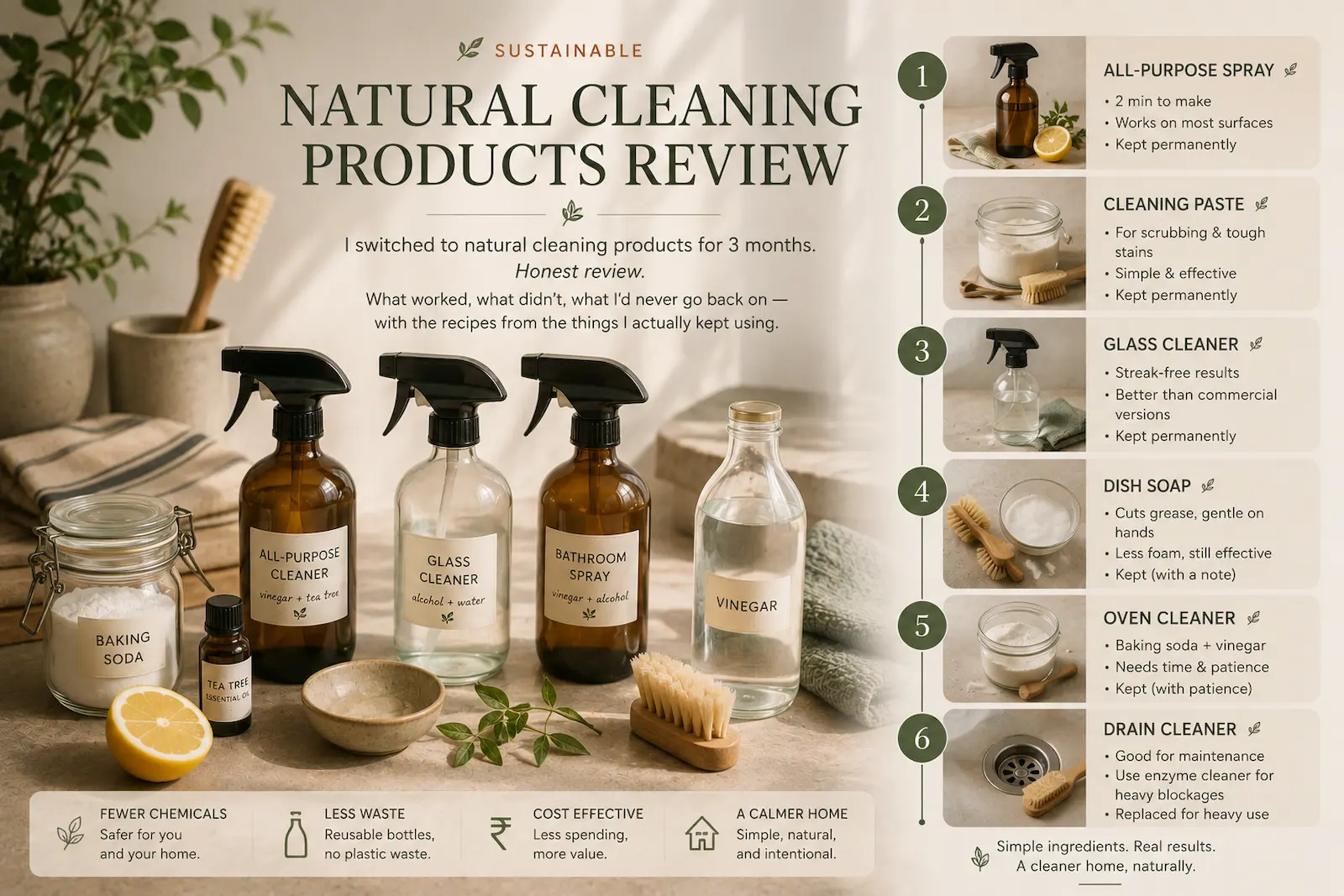
All-purpose disinfectant spray ✓ Kept permanently
This was the first thing made and the first genuine convert. The disinfectant spray — water, vinegar, rubbing alcohol, tea tree oil — takes two minutes to make and genuinely works on kitchen counters, bathroom surfaces, and door handles. The tea tree oil is what gives it real antimicrobial action beyond the vinegar.
The only adjustment: double the rubbing alcohol in the bathroom version for stronger disinfection. Kitchen version stays as the recipe. Never went back to a commercial spray.
All-purpose cleaning paste ✓ Kept permanently
The baking soda and castile soap paste replaced the abrasive bathroom cleaner and the separate sink scrub. For anything that needs scrubbing rather than spraying — grout, sink basins, stovetop rings — it is the most effective thing tested. Takes five minutes to make. Lasts weeks.
Glass cleaner ✓ Kept permanently
The rubbing alcohol and water glass cleaner outperformed the commercial version. Genuinely streak-free when used with a microfibre cloth. The commercial cleaner had been leaving faint smears that weren't visible until sunlight hit them. The homemade version does not.
Liquid dish soap ✓ Kept, with a note
The Sal Suds-based dish soap cuts grease effectively and is noticeably gentler on hands than commercial dish soap. The note: it does not foam as much as commercial versions, which takes adjustment. The foam in commercial dish soap is mostly sodium lauryl sulphate, which is a foaming agent rather than a cleaning agent. Less foam does not mean less clean — but the adjustment period is real.
Oven cleaner ✓ Kept, with patience
The baking soda and vinegar overnight method works — but works slowly. For a mildly dirty oven, one overnight application is enough. For a seriously neglected oven, it may need two or three rounds. This is not a failing; it is simply a different pace. The commercial oven cleaner worked faster because it contained lye — a highly caustic alkali that also produces fumes that require ventilation. The natural version takes longer and requires no protection at all.
Drain cleaner ✗ Replaced for heavy blockages
For maintenance and mild slow drains, baking soda and vinegar works well used monthly. For a seriously blocked drain, it does not have enough force. An enzyme-based commercial drain cleaner — not the caustic chemical kind — was kept for genuine blockages. The homemade version handles prevention; the enzyme cleaner handles cure.
The first two weeks, the doubt that anything was actually clean persisted. The surfaces looked clean. They smelled faintly of vinegar for thirty seconds, then nothing. But the absence of the strong chemical smell felt like absence of cleanliness.
That feeling passed around week three. What replaced it was something quieter — surfaces that smelled of nothing, which is what genuinely clean surfaces smell of.
What the three months cost and saved
The upfront ingredient purchase — vinegar, baking soda, castile soap, rubbing alcohol, essential oils, glass bottles — came to approximately ₹1,200. This sounds like more than buying a few cleaning products, which it is initially.
Over three months, those ingredients covered all cleaning products for the entire household. No single-use bottles purchased. No restocking mid-month. The per-use cost was a fraction of what the previous arrangement cost.
Beyond money: the cleaning cupboard went from eight bottles to three glass spray bottles and one jar. The visual simplicity alone changed how the space felt — which connects to what intentional home organisation is actually about. Fewer things, each doing their job fully.
The step-by-step switching guide
- Audit what you currently use. List every cleaning product in the house, what it does, and how often you use it. Most households have significant duplication — three products doing the same job, several products rarely used.
- Start with the all-purpose spray. It is the most used product in most homes and the easiest to replace. Make one batch, use it for two weeks, see how it feels. Do nothing else yet.
- Replace products as they run out. Do not throw away existing products. When the dish soap runs out, replace it with homemade. When the bathroom spray runs out, replace it. Natural attrition over 6-8 weeks completes the transition without waste or overwhelm.
- Buy glass bottles once. A 500ml glass spray bottle with a good nozzle is the only equipment needed. Buy two or three. They last indefinitely and are the only upfront cost beyond ingredients.
- Learn the surface rules. Write them on a sticky note inside the cupboard until they're second nature: no vinegar on stone, no abrasive paste on delicate surfaces, glass cleaner safe on everything. Knowing this prevents the one genuine risk in homemade cleaning.
- Visit the full cleaning recipe collection at Make at Home — Home Cleaning for every recipe covered in this review, with exact measurements and surface guidance.
Real-life applications — the weekly cleaning routine
After three months, the cleaning routine simplified significantly. Not because less cleaning was happening — but because fewer decisions, fewer products, and fewer trips to the cupboard were involved.
Daily
All-purpose spray on kitchen counters and stovetop after cooking. Takes 90 seconds. No separate surface spray, no separate cooktop cleaner.
Weekly
Glass cleaner on mirrors and windows. Cleaning paste on bathroom sink and taps. All-purpose spray on toilet seat and bathroom surfaces. Dish soap replenished if needed.
Monthly
Baking soda and vinegar down all drains as preventative maintenance. Cleaning paste on oven interior. Review of ingredient levels to see what needs restocking.
"The cleaning cupboard went from eight single-use bottles to three glass spray bottles and one jar. Fewer things, each doing their job fully."
What I would never go back on
After three months, three things were permanently off the list regardless of anything else:
- Commercial glass cleaner. The homemade version is genuinely better. There is no argument for going back.
- Commercial all-purpose spray. The same. The homemade version works, costs almost nothing per use, and doesn't coat surfaces with synthetic fragrance.
- Single-use plastic cleaning bottles. Glass bottles with refillable ingredients are strictly better in every dimension — cost, waste, aesthetics, shelf life.
The experiment also reinforced the broader principle behind zero-waste kitchen habits: most of what appears to require a specialised product does not. A handful of simple ingredients cover an enormous range of needs. The specialisation is mostly marketing.
Three months. Six ingredients. Most of the cleaning cupboard replaced. The honest summary: it works, it costs less, it produces less waste, and the transition is easier than it looks. The hardest part is the first two weeks of doubting that something is clean because it doesn't smell like chemicals. That doubt is worth pushing through.
Common questions
Do natural cleaning products actually disinfect, or just clean?
This depends entirely on the recipe. Vinegar alone is a cleaner but not a reliable disinfectant. A spray combining rubbing alcohol (70%), tea tree oil, and water does have genuine antimicrobial properties. The distinction matters most in bathrooms and on food preparation surfaces. For daily countertop wipes, most natural sprays are sufficient. For genuine disinfection, the alcohol-based spray is the one to use.
Are natural cleaning products safe for all surfaces?
No — and this is the most important thing to get right before switching. Vinegar-based cleaners will etch and damage marble, granite, natural stone, and cast iron over time. The cleaning paste should not be used on delicate surfaces. The glass cleaner and disinfectant spray are the most universally safe. When in doubt, test on a small inconspicuous area first.
How much does it actually cost compared to shop-bought products?
The upfront cost of buying ingredients is higher than buying a single bottle of cleaner. But these ingredients make multiple batches over months. The per-use cost of homemade cleaning products is typically 60-80% lower than commercial equivalents once the initial ingredients are in the house. The glass bottle and spray nozzle pay for themselves within the first two refills.
What's the hardest part of switching — what do most people struggle with?
The hardest part is the trust gap. Commercial cleaners smell strongly of artificial fragrance, which the brain has been conditioned to associate with clean. Natural products often smell mild or like vinegar. The doubt that something is actually working, even when it is, is what causes most people to give up in the first two weeks. This passes after about a month.
Do you need to make everything at once, or can you switch gradually?
Gradual switching is significantly more sustainable and less overwhelming. The best approach: when a commercial product runs out, replace it with a homemade version. Start with the all-purpose spray and dish soap. Once those feel normal, add the glass cleaner, then the cleaning paste. A full switch usually takes 2-3 months of natural attrition and replacement.
What about the smell — does the vinegar smell linger?
The vinegar smell dissipates completely as the spray dries — usually within 2-3 minutes. It does not linger. Adding 10-15 drops of lemon, eucalyptus, or peppermint essential oil masks the vinegar smell during application and leaves a faint, pleasant scent. The key is not over-spraying — one or two sprays per surface is enough.