The version of zero-waste living that gets the most attention online involves a family of four fitting an entire year of rubbish into a single mason jar. It is an impressive image. It is also, for most people in most kitchens, an unreachable one that functions more as discouragement than inspiration.
The version that actually works is less dramatic and considerably more durable: one swap at a time, when the previous thing runs out, in order of impact rather than aesthetics. No clear-out of the existing kitchen. No special shops required. No guilt about the things you haven't changed yet.
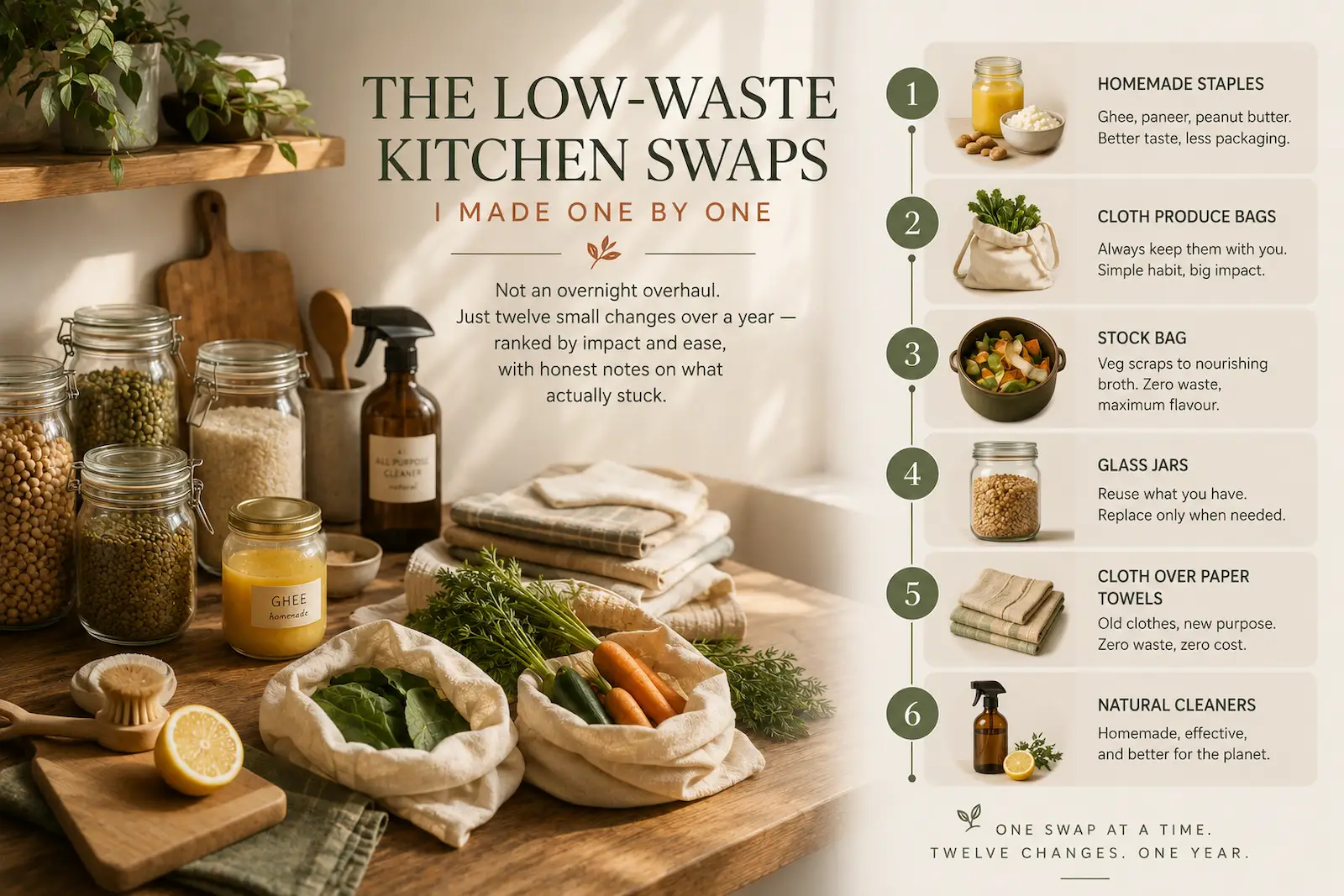
These are the twelve swaps made over the course of a year, ranked honestly by how much difference they made and how easy they were to maintain.
How to read this list — the ranking system
Each swap is rated on two dimensions: impact (how much waste it actually eliminates) and ease (how much friction it adds to daily life). The highest-value swaps are high impact and low friction. The ones at the bottom of the list are either lower impact or higher friction — not not worth doing, just worth doing later.
Do not throw away anything functional to replace it with something sustainable. Use what you have until it wears out, then replace it better. Discarding a working plastic container to buy a glass one is waste, not progress. The swap happens at the natural end of each item's life.
The twelve swaps — ranked by impact
1. Making staples at home instead of buying packaged
Impact: very high. Friction: low after the first few times.
This is the highest-leverage swap in the kitchen, and it also happens to produce better results than the packaged version. Making ghee, paneer, and peanut butter at home eliminates several plastic purchases per month and replaces them with things that taste noticeably better. The time investment — 30 minutes for ghee, 20 for paneer — happens once every few weeks.
2. Cloth bags for produce and bulk buying
Impact: high. Friction: very low once it becomes habit.
Keeping cloth bags in every bag you regularly carry means they are always available. The friction is almost entirely in the transition period — the two weeks of occasionally forgetting them. After that, it becomes automatic. For bulk grains and lentils, taking your own containers to the shop eliminates packaging entirely for the highest-volume items in most Indian kitchens.
3. A stock bag in the freezer
Impact: high. Friction: none.
A cloth bag or container in the freezer into which onion skins, carrot peels, celery leaves, herb stems, and corn cobs go throughout the week. When full, simmer with water for an hour, strain, and refrigerate. This replaces bought stock entirely and eliminates one of the most common sources of kitchen waste. No extra time — the peels were going in the bin anyway.
4. Glass jars for storage
Impact: medium-high. Friction: low.
The transition from plastic containers to glass jars happens naturally: when a plastic container cracks or warps, it gets replaced with a glass jar. Old pickle jars, pasta sauce jars, jam jars — all repurposed. Buying no new containers, just cleaning and reusing. Over a year, the kitchen organically shifts toward glass without any deliberate purchasing.
5. Cloth over paper towels
Impact: medium-high. Friction: low once the rags are in place.
Old cotton clothing — worn-out kurtas, faded dupattas, shirts past their use — cut into rough squares and kept in a basket on the counter. Used exactly as paper towels are used: for wiping surfaces, hands, spills. Washed with the regular laundry. The stack depletes and is replenished from the laundry the way paper towels would be from the packet — except the cost is zero and the waste is zero. The only adjustment: having a small bin nearby for used cloths rather than the bin.
6. Beeswax wraps over cling film
Impact: medium. Friction: low.
Beeswax wraps cover bowls, wrap cut vegetables, and do most of what cling film does. They do not stretch in the same way, which requires a small adjustment. They last 6-12 months of regular use. The one thing they cannot do is go in the microwave — a small plate works instead.
7. A compost system for unavoidable food waste
Impact: medium. Friction: medium initially, low once the system is established.
Even a small countertop compost bin — emptied into a larger outdoor container or given to a nearby community garden — redirects significant organic waste from landfill. The adjustment is primarily about establishing the habit of separating food scraps rather than putting everything in the same bin.
8. Loose leaf tea over tea bags
Impact: medium. Friction: negligible.
Most tea bags contain plastic in the sealing — a fact that was surprising and motivating. Loose leaf tea with a simple strainer produces better tea, generates no plastic waste, and the used leaves can go directly into the compost or garden. The switch took one purchase of a cheap metal strainer and one bag of loose leaf tea.
9. Buying the largest available size of everything
Impact: medium. Friction: none.
Packaging-to-product ratio improves significantly with size. A 5kg bag of atta produces less packaging waste per kg than five 1kg bags. A 2-litre bottle of oil produces less waste than four 500ml bottles. No behaviour change required — just a different size of the same thing already being bought.
10. Homemade cleaning products
Impact: medium. Friction: low after the first batch.
Making the cleaning products covered in the natural cleaning products review eliminates multiple plastic bottles per month and replaces them with glass bottles refilled from bulk ingredients. The complete home cleaning recipe collection covers every product replaced.
11. A reusable water bottle and coffee cup
Impact: lower than expected. Friction: none.
This is usually the first swap people make and the one that gets the most attention — but it ranks lower here because the impact, while real, is smaller than the kitchen staple and produce swaps above it. Worth doing, but not worth doing first.
12. Saying no to packaging at the source
Impact: variable. Friction: requires asking.
Asking the sabziwala to skip the plastic bag. Declining the extra napkins with takeaway. Asking the sweet shop to use your container. Small, repeated, and surprisingly effective — not because each refusal is significant, but because the habit of noticing and asking changes what you accept as default.
"The most effective low-waste kitchen is not the one with the most sustainable products. It is the one where the least unnecessary buying happens at all."
What happened after a year
After twelve months of one-swap-at-a-time transitions, the kitchen bin goes out approximately half as often as it did before. The grocery run produces less packaging. The cleaning cupboard has three glass bottles instead of eight plastic ones. The pantry has more glass jars and fewer single-use packets.
None of it happened dramatically. Each swap was small enough that it barely registered as a decision at the time. The cumulative effect is what surprised — how much the kitchen changed without any single moment of change.
This is the principle behind intentional organisation applied to sustainability: systems and small repeated decisions rather than dramatic overhauls. And it connects to the broader guide on building a zero-waste kitchen — which provides the foundational principles that underpin each of these swaps.
Start with swap one. Make it until it feels normal — about two to four weeks. Then add swap two. Twelve swaps, twelve months, a kitchen that produces significantly less waste without ever requiring a dramatic gesture. The most sustainable change is the one that doesn't feel like change after the first month.
Common questions
Do I need to throw away all my existing plastic to start a low-waste kitchen?
No — and throwing away functional items to replace them with sustainable alternatives is itself a form of waste. The low-waste approach is to use what you have until it wears out, then replace it with something better. Start with what runs out or breaks, not with a clear-out.
What's the single highest-impact swap for most kitchens?
For most households, the highest impact swap is moving staples from packaged products to homemade versions — specifically ghee, paneer, curd, and peanut butter. These four items account for a significant portion of kitchen plastic packaging, and the homemade versions are noticeably better. After that, switching to cloth bags and bulk buying has the next highest impact.
How do you handle food waste — what actually works?
The most effective approach to food waste is not composting — it is buying less. Composting is the correct response to unavoidable food waste, but the real leverage is in meal planning, using vegetable scraps for stock, and storing things so they last longer. A simple stock bag in the freezer eliminates one of the most common sources of vegetable waste.
Are these swaps realistic in an Indian kitchen with a joint family?
Most of these swaps are particularly well-suited to Indian kitchens. Making ghee, paneer, and curd at home is traditional practice in many Indian households. Bulk buying, cloth bags, and avoiding packaged snacks align naturally with how many Indian households already shop. The adjustments needed are smaller than they might appear.
What do you do about plastic packaging that seems unavoidable?
Some packaging is genuinely unavoidable at present. The approach is to accept unavoidable packaging without guilt while eliminating avoidable packaging with intention. Buying the largest available size reduces the packaging-to-product ratio significantly. Choosing loose produce over bagged produce wherever available makes a meaningful difference without requiring any special shops.
How long does it take before a low-waste kitchen feels normal rather than effortful?
Each individual swap takes approximately two to four weeks to feel normal. A full kitchen transition across twelve swaps, done one at a time, takes roughly a year. But after the first three or four swaps are in place, the process accelerates — the mindset shifts before the kitchen does, and subsequent swaps require less deliberate effort.