Most accounts of quitting social media follow a particular narrative arc: person leaves platform, person becomes more productive, person reads twelve books in a month, person is now happier and better. It is a satisfying story. It is also not quite the story that tends to actually happen.
The actual story is quieter, stranger, and more interesting. It involves a lot of boredom before it involves anything else. It involves reaching for a phone that has nothing on it. It involves the slow, slightly uncomfortable realisation that you had been using a small screen to avoid being present in your own life — not dramatically, not destructively, but consistently.
This is that story. And it connects directly to the broader question of what digital minimalism actually means in practice.
What the experiment involved
The setup was simple: delete the Instagram app for 30 days. Not deactivate the account — just remove the app. The account would stay up, DMs would still arrive via email notification, but the ambient feed — the scroll — would be gone.
No productivity goals. No intentions to fill the time with improving activities. No journalling about the experience (beyond some notes). Just the absence, and the observation of what filled it.
Willpower-based restrictions with social media tend to fail because the apps are designed to be opened reflexively — before the conscious mind has engaged. Deleting the app removes the reflex. You can still choose to use Instagram on a browser, which requires a deliberate decision each time. That small friction is doing significant work.
Week by week — what actually happened
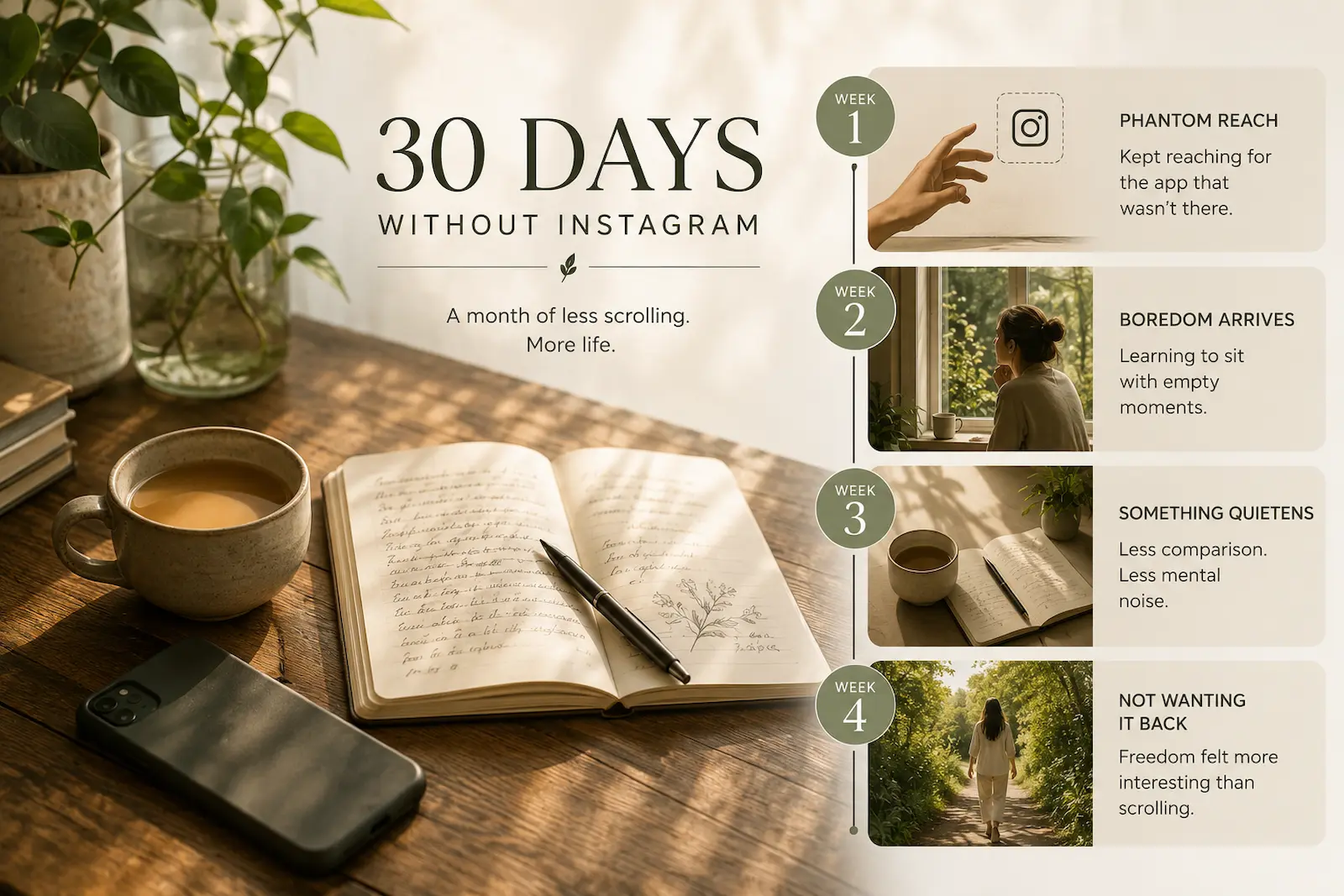
The hand kept moving to where the app used to be. Multiple times a day. Noticing this — really noticing it — was the first genuinely interesting thing the experiment produced.
Genuine, unoccupied boredom — the kind that has nowhere to go. Uncomfortable at first. Then, slowly, productive in a different way than expected.
A particular kind of background noise — comparison, mild social anxiety, the low hum of "I should post that" — faded. Not dramatically. Just... less.
The anticipated relief of returning to the app at day 30 didn't arrive. The more interesting feeling was not wanting to go back to the previous relationship with it.
The boredom question — what actually filled the space
Here is what most accounts of social media detox get wrong: they imply that the time you recover is automatically available for meaningful things. It is not. The first week, most people find the recovered time filled with other phone behaviour — other apps, longer WhatsApp sessions, more YouTube. The hand that wants to scroll will scroll something.
The genuinely interesting change comes in the second and third weeks, when the phone stops being the automatic answer to a moment of pause. What happens in those pauses — when the hand reaches and finds nothing it wants — is the actual content of the experiment.
More looking out of windows. More conversations that didn't start with "have you seen this". More time in the kitchen — making things rather than photographing them. More mornings that stayed slow because there was nothing to check.
The connection to slow morning routines is real: the absence of the phone check in the first 20 minutes of the day changed the tone of everything that followed.
What the experiment revealed about comparison
One of the more surprising things about removing Instagram for 30 days was how much of what it had been delivering was not connection but comparison. Not maliciously — not from following the wrong accounts or feeling inadequate in any dramatic way. Just the constant, low-level calibration of one's own life against the presented versions of other lives.
This calibration is so constant and so normalised that most people don't notice it until it stops. When it stops, the relief is not the relief of suddenly feeling better about your life. It is the relief of no longer being asked the question.
"The relief is not feeling better about your life. It is no longer being asked to constantly compare it."
The same principle applies to physical clutter and home organisation: both social media and physical disorder ask something of your attention constantly. Removing either creates space that you didn't know was being occupied.
Real-life applications — step by step
If you want to run the experiment yourself, here is a clean process:
Before you delete
Spend five minutes noting why you use Instagram: is it for connection with specific people, creative inspiration, information, habit, or something else? Being specific about what you value helps you figure out what to replace it with — and what you don't actually need back.
Day one
Delete the app. Not deactivate — delete. Tell one or two people who would normally reach you via DM to use another channel this month. That is the entire setup.
The first week
Notice the phantom reach. Count it if you like — some people find it useful to put a tally mark on a sticky note each time. The number is usually surprising. This is not a failing. It is information about how habitual the behaviour was.
Week two onwards
Pay attention to what you do with unscheduled pauses. The waiting room, the lift, the first five minutes of waking up. These are the moments where Instagram was doing the most work. What happens there now is the data.
This connects naturally to the 30-day waiting principle — the insight that time between impulse and action reveals what you actually want. The same is true here: time between the urge to check and the ability to check reveals what the checking was actually for.
Day 30
Before redownloading, write down — honestly — what you want from the app going forward, and on what terms. Most people who do this end up not returning to their previous relationship with it, even if they return to the platform.
What a healthier relationship looks like
A social media break that ends in the same relationship with the platform as before is just a holiday. The point is to return — if you return — with a different arrangement. Some options:
- Desktop only. No app on the phone. Use it on a computer, once a day, for a fixed amount of time. The change in context changes the behaviour completely.
- Two sessions a week. Tuesday and Friday evenings, 20 minutes. Everything else, the app doesn't exist.
- Posting without consuming. Some people find they genuinely value creating and sharing, but not scrolling. Post, close, don't open the feed.
- A greyscale phone. Turn the phone screen to greyscale in accessibility settings. The colour-drain makes everything on it less stimulating and the apps less rewarding to open. This is one of the changes covered in more detail in making your phone boring on purpose.
The goal is not to be the person who doesn't have Instagram. It is to be the person who uses it on their own terms rather than the platform's.
For anyone wanting to go further with reducing digital noise, the practical framework in digital minimalism provides the broader context for these individual decisions.
Thirty days. One deleted app. The productivity gains, if there were any, were secondary. What the month actually delivered was a clearer picture of a relationship that had become so habitual it had stopped being a choice. Seeing that — really seeing it — is worth the thirty days on its own.
Common questions
Will I miss out on things if I delete Instagram?
The fear of missing out is real but usually overstated. Most of what Instagram delivers — news, events, updates from friends — exists in other channels. What you actually miss is the ambient stream of what everyone is doing, which is a different thing. Most people who take a break find that genuinely important information found its way to them anyway, through messages, conversations, or other means.
Should I deactivate or just delete the app?
Deleting the app is significantly more effective than deactivating the account. Deactivating requires a deliberate decision to return. Deleting removes the reflex — the hand that moves to the phone icon and finds nothing there. The account stays intact; you can redownload and log in any time. But the friction of redownloading is surprisingly powerful at interrupting automatic behaviour.
What do you actually do with the time you get back?
This question assumes the time arrives as a gift, already packaged. It doesn't. The first week, the time tends to get filled with other phone behaviour — other apps, other scrolling. The interesting shift happens when you notice that too, and start making deliberate choices. Many people return to things they'd stopped doing: reading longer pieces, cooking, going outside, having unscheduled conversations.
Does it affect your mood, or is that overstated?
The mood research on social media is complex and contested, but personal experience tends to align: most people report feeling somewhat calmer and less comparative after a few weeks off. The effect is less about positive mood gains and more about the reduction of a particular kind of background agitation — the low hum of comparison, the mild anxiety of not having checked, the minor flatness after seeing someone else's highlight reel.
How do you handle it professionally — what if Instagram is part of your work?
If Instagram is genuinely part of your work, a full 30-day deletion may not be realistic. A useful alternative: keep a desktop-only rule (use it on a computer, never on your phone), set fixed posting and checking times (twice a week, for 20 minutes), and treat it like any other work tool rather than a personal one. The goal is removing it from the ambient layer of your day, not from your life.
What's the difference between a social media break and actual digital minimalism?
A break is temporary and often followed by a return to the same relationship with the platform. Digital minimalism is a set of permanent, intentional decisions about which technologies add genuine value and on what terms. A break is useful as a reset and an experiment. Digital minimalism is what you build from what the break reveals.