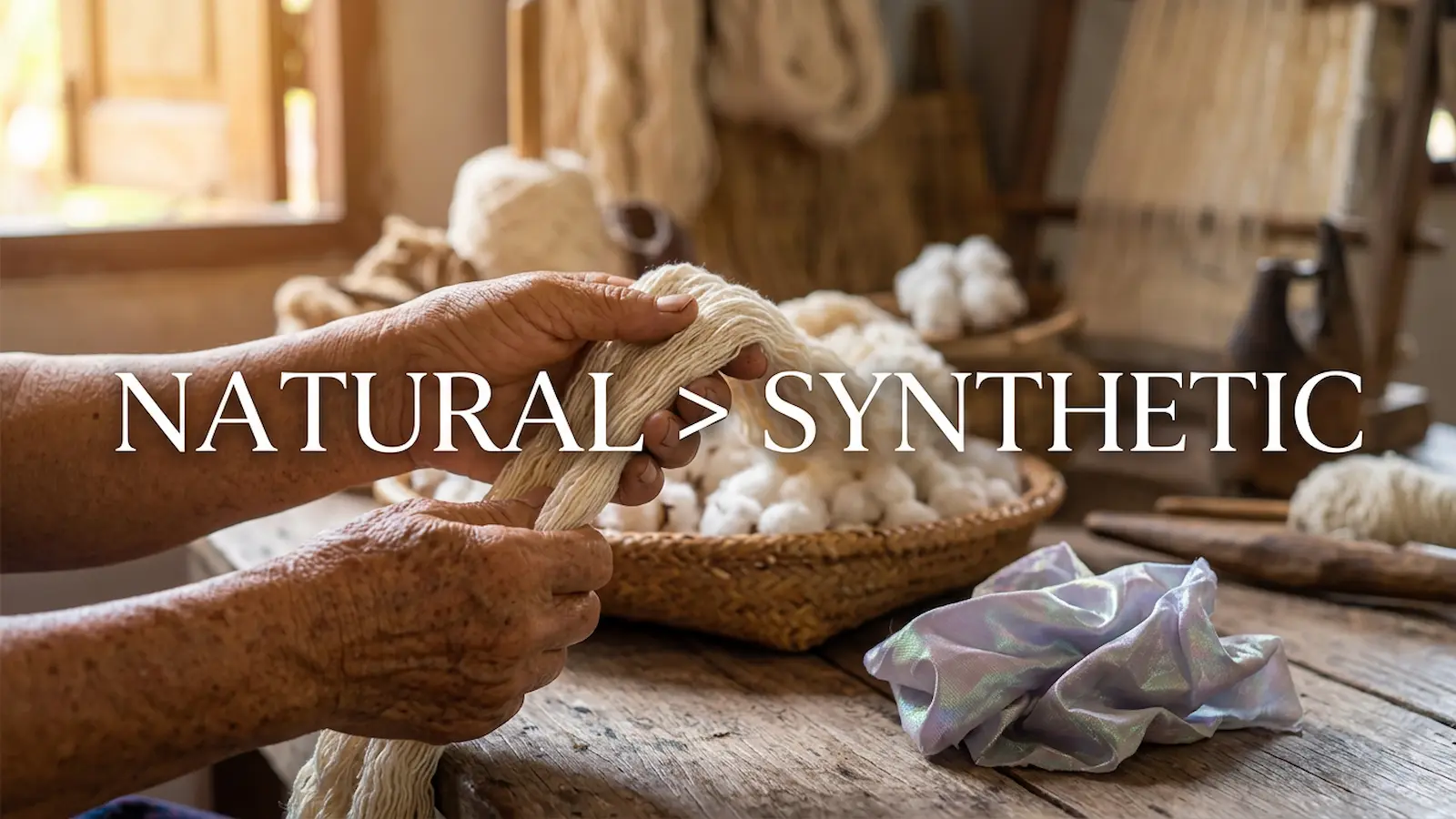
There is a moment in most people's relationship with their wardrobe when they pick up a kurti they own in three colours, realise it has never quite felt right against the skin, and check the label. Polyester blend. Of course.
Fabric content is one of the most consequential and least-read pieces of information attached to the clothes we wear. We choose by colour, cut, pattern, price — and then live with the consequences of the fibre on our skin for every hour we are wearing it. In India, where temperatures regularly exceed 35°C and humidity makes some months feel like wearing warm wet paper, the fabric content of what you wear is not a small consideration. It is the difference between a day that is physically tolerable and one that isn't.
This is an honest breakdown — not from a textile engineer, but from someone who has gradually rebuilt a wardrobe around natural fibres and noticed the difference. Covered here: what each major natural fabric is, how it performs across skin, sustainability, and practical care, and how it compares to the synthetic alternatives that dominate most mid-market Indian clothing.
If you're in the process of building or editing your wardrobe intentionally, the principles here pair directly with the capsule wardrobe approach — fewer pieces, chosen more carefully, that work harder and last longer.
Why fabric content actually matters
Before the individual fabrics: a brief case for why this is worth knowing at all.
Your skin is your largest organ. It breathes, regulates temperature, absorbs compounds from what it contacts, and responds to friction and moisture. What you wear is in constant contact with it for 12-16 hours a day. The idea that fabric content is a minor consideration — something only people with sensitive skin need to think about — doesn't hold up.
Synthetics are plastic fibres. Polyester, nylon, acrylic are all petroleum derivatives. They do not breathe, do not absorb moisture, and trap heat against the skin. They also shed microplastics with every wash — an estimated 700,000 microplastic fibres per wash cycle — which enter water systems and ultimately food chains. None of this is catastrophic in a single garment. Across a wardrobe, worn daily, washed weekly, for years, it adds up.
Natural fibres are not perfect — they require more care, cost more, and some have significant environmental footprints in production. But for everyday wear in a warm climate, they are measurably more comfortable and measurably less ecologically costly over time.
Fabric labels list fibre content by percentage in descending order. "65% polyester, 35% cotton" means the majority is plastic. Look for labels where the natural fibre is listed first and accounts for at least 80%. Anything below 50% natural fibre will behave more like a synthetic than a natural fabric in terms of breathability and moisture management.
The five natural fabrics worth knowing
How natural fibres compare to synthetic alternatives
| Property | Cotton / Linen | Silk / Wool | Polyester / Nylon |
|---|---|---|---|
| Breathability | Excellent | Excellent | Poor |
| Moisture management | Absorbs well | Regulates | Traps against skin |
| Skin comfort in heat | Very good | Depends on weight | Uncomfortable |
| Durability | Good with care | Excellent (decades) | Good but pills and degrades |
| Environmental impact | Moderate (better organic) | Moderate | High (microplastics, fossil fuels) |
| Cost per wear | Low over time | Very low over time | Cheap upfront, replaces faster |
| Care requirements | Easy | Requires attention | Easy |
What this looks like in practice — the Indian wardrobe
The Indian wardrobe has a natural advantage that often goes unacknowledged: traditional Indian clothing was developed for the Indian climate, and traditional Indian textiles — cotton, linen, silk, handloom fabrics — are almost entirely natural fibres. Khadi is cotton. Chanderi is cotton-silk. Kanjivaram is silk. Pashmina is wool. The alignment between traditional Indian dress and natural fibres is not coincidental — it evolved over centuries of living in this climate.
The shift toward synthetic fabrics in Indian fashion is relatively recent and driven primarily by cost and wrinkle-resistance rather than comfort or quality. A polyester kurti costs less to produce, holds its shape after washing without ironing, and photographs well. It is optimised for production economics, not for wearing in Ahmedabad in May.
"Traditional Indian textiles were developed for the Indian climate. Khadi, chanderi, kanjivaram, pashmina — the alignment between traditional Indian dress and natural fibres evolved over centuries. The shift to synthetics is recent and driven by production cost, not comfort."
A practical wardrobe for the Indian climate built around natural fibres might look like:
- Summer daily wear: 100% cotton or linen kurtas, cotton salwars, linen trousers. Handloom cotton if available — it breathes better than mill cotton.
- Year-round basics: Cotton innerwear exclusively. Cotton bedding. Cotton or linen dupattas.
- Occasion wear: Silk sarees, chanderi or cotton-silk kurtas. Deliberate pieces bought once and worn for decades.
- Winter (North India / hills): Fine wool or merino shawls and sweaters. One good pashmina shawl replaces three synthetic alternatives and lasts twenty years.
This connects naturally to the minimalism in an Indian home approach — the same principle of fewer things, better chosen, applies to the wardrobe as much as it does to the living space. And tracking what you actually wear (as opposed to what you own) is made easier by having fewer, more deliberate pieces — which is exactly what the capsule wardrobe framework is built around.
The yoga and activewear myth — what the industry sold us
Perhaps nowhere is the synthetic fabric industry's marketing more effective — or more worth questioning — than in yoga and movement-based exercise. The premise is now so normalised it feels like fact: you need technical synthetic fabric to exercise. Polyester leggings, nylon tops, spandex everything. To suggest otherwise is to invite raised eyebrows.
It is worth pausing on how recently this became the default, and whose interests it serves.
Yoga has been practised on the Indian subcontinent for at least 2,500 years. The practitioners of classical yoga — and the tradition continues in many forms today — wore cotton and mulmul (fine muslin). Rooted in Indian daily life, these were not performance fabrics engineered for athletic use. They were simply what people wore. Loose cotton dhoti and angavastra for movement practices. Breathable, light, skin-friendly. Cotton has been cultivated in India since at least 2500 BCE — India was one of the first places where cotton was cultivated and used even as early as 2500 BCE during the Harappan era — and its suitability for the Indian climate was not a marketing claim. It was millennia of practical evidence.
The ancient Indian textile tradition also included Ayurvastra — a Sanskrit word meaning 'health cloth'. These fabrics, processed with medicinal herbs, were worn to support health and well-being, with origins traced back to Ayurveda, Yoga, and the Vedas, dating as far back as 1,000 to 1,500 BCE. The idea that what touches the skin during practice matters is not new. What is new is the industry that decided synthetic petroleum-derived fibres should be what touches the skin during practice.
The synthetic activewear industry — dominated by brands like Nike, Lululemon, and Adidas — grew substantially from the 1980s onwards, driven by the sportswear boom and the invention of moisture-wicking polyester fabrics. The marketing proposition was simple: natural fibres absorb sweat and stay wet; synthetic fibres wick sweat away from the body and dry quickly. Therefore synthetics are superior for exercise.
This argument has two problems. First, it conflates different types of movement. For high-intensity interval training or running in cold weather, rapid moisture removal does serve a function. For yoga, Pilates, stretching, walking, and low-to-moderate intensity movement — which accounts for the majority of exercise most people actually do — the argument largely does not hold. Cotton absorbs sweat and, crucially, allows the body's natural cooling mechanism to function: sweat is meant to evaporate from the skin surface, cooling it in the process. Polyester traps moisture against the skin rather than allowing evaporation, which in a warm climate like India's actively works against the body's thermoregulation.
Second, the skin's pores are open during a workout and sweat is flowing, making it even more likely to absorb toxins. Synthetic fabrics like polyester, nylon, and spandex can be treated with chemicals called PFAS, which are toxic and moisture-wicking — meaning many workout clothes on the market contain them. The fabric you wear during the moments your skin is most absorbent is worth scrutinising.
Try practising yoga or doing a home workout in a loose 100% cotton kurta or cotton t-shirt on a day you would normally wear synthetic activewear. The cotton will absorb sweat — which is what it is supposed to do. The body will cool itself — which is what it is supposed to do. The practice will not be impeded. What will be different is the absence of the synthetic smell that activewear develops after a few months of use, and the absence of the plastic-against-skin sensation that becomes obvious only when it's gone.
None of this means synthetic activewear is without any legitimate use. For cold-weather outdoor exercise — running in winter, high-altitude trekking — the moisture management argument is genuinely valid. A wet cotton layer in cold conditions is a genuine problem. For outdoor extreme sports, technical synthetic fabrics serve real functional purposes.
But for yoga in a Mumbai flat in July, or a morning walk in Jaipur, or a home workout in Bangalore — the synthetic activewear is largely a marketing success story, not a functional necessity. Cotton and natural alternatives provide the same level of comfort for those who don't want to sweat in polyester, for the benefit of their bodies and the planet. The dhoti-clad yoga practitioners of ancient India were not working against their practice. They were dressed exactly right for it.
Building the habit of reading labels
The shift toward natural fibres doesn't require discarding everything in the wardrobe at once — that would be waste, not sustainability. It requires one habit: reading the label before buying anything new.
This habit, like all the small behavioural changes discussed in the context of low-waste swaps, compounds over time. Each new garment bought with conscious attention to fibre content gradually shifts the wardrobe's composition toward natural fibres — not dramatically, but durably.
The practical version:
- Check the label before trying anything on. If it's below 80% natural fibre, put it back. The try-on creates attachment that overrides the label check if it happens after.
- Pay more per piece, buy fewer pieces. A ₹1,200 100% cotton handloom kurta worn 200 times costs ₹6 per wear. A ₹400 polyester kurta worn 40 times costs ₹10 per wear and goes to landfill. The arithmetic of cost per wear almost always favours quality natural fibres.
- Replace, don't supplement. When a synthetic garment wears out, replace it with a natural fibre equivalent. This is the same gradual swap logic as the low-waste kitchen transition — one at a time, at the natural end of each item's life.
- Learn your local fabric sources. Most Indian cities have fabric markets or handloom shops that sell natural fibre fabric by the metre at prices lower than ready-made synthetic garments. Getting clothes stitched locally from natural fabric is often cheaper and better than buying ready-made synthetic clothing.
The wardrobe is one of the most intimate relationships we have with material goods — worn against skin, present for every day of life. The fabric it's made of is not a small detail. In a climate like India's, it is the detail that determines whether getting dressed feels like armour or comfort. Natural fibres, chosen well and cared for properly, reliably provide the latter.
Common questions
Which fabric is best for the Indian summer — cotton or linen?
Both work well but differently. Cotton absorbs moisture quickly and feels soft, making it comfortable for everyday wear. Linen wicks moisture away and dries faster, which makes it slightly cooler in dry heat and more comfortable outdoors for extended periods. In humid coastal climates, linen's faster drying is a significant advantage. In drier inland heat, both perform comparably. For daily urban wear, cotton is more practical. For outdoor or formal summer wear, linen is often the better choice.
Is bamboo fabric actually sustainable, or is it greenwashing?
Bamboo as a plant is genuinely sustainable. The problem is in the processing — most bamboo fabric sold as eco-friendly is bamboo viscose, which requires intensive chemical processing. Mechanically processed bamboo (bamboo linen) is genuinely sustainable but rare and expensive. When buying bamboo fabric, check the processing method. If it says viscose or rayon, the sustainability claims are significantly overstated.
Why does polyester feel uncomfortable in Indian weather?
Polyester is a plastic-derived fibre with virtually no breathability. It does not absorb moisture, which means sweat sits on the skin rather than being wicked away. In India's warm and often humid climate, this creates trapped heat and moisture against the body that natural fibres avoid. Polyester performs well in cold climates as a base layer — the context it was originally developed for. For warm-weather daily wear in India, it is genuinely unsuited.
Is silk worth the cost for everyday Indian wear?
Silk is not practical for daily wear — it requires hand washing, cannot be wrung, fades in direct sunlight, and marks easily. Its value is in occasion and festive wear, where its drape and temperature-regulating properties are unmatched. For the Indian wardrobe, silk's cultural significance makes it worth owning in limited, deliberate pieces rather than avoiding entirely. One or two well-chosen silk pieces worn for years are a sounder investment than multiple lower-quality alternatives.
What about wool — is it relevant for Indian wardrobes?
Wool is highly relevant for North India, hill stations, and altitude during winter. Fine merino wool is particularly versatile — it regulates temperature across a wide range and is naturally odour-resistant (a week of wear between washes is normal). The perception that wool is scratchy comes from coarser varieties. Merino, pashmina, and fine Himalayan wool are soft enough for direct skin contact. One good merino sweater lasts longer than many acrylic alternatives and performs significantly better.
How do I identify fabric content when labels are missing or vague?
A simple burn test identifies most common fibres. Natural fibres burn cleanly and smell like burning hair or paper, leaving a soft grey ash. Synthetic fibres melt rather than burn, smell chemical, and leave a hard bead of plastic. For fabrics you cannot test, hold the fabric against your inner wrist for 30 seconds — natural fibres remain cool or neutral, synthetics feel warm and slightly damp. Price is also a rough guide: genuine natural fabrics cost more to produce.